
It’s one of the most common questions we receive from Malaysia’s multicultural population — Chinese, Malay, Eurasian, and mixed-heritage callers alongside Tamil and broader Indian ones. If Nadi astrology is a Tamil tradition, does it only “work” for people of Tamil or Indian descent?
The honest, direct answer: no. Your leaf isn’t assigned based on ethnicity, nationality, religion, or birthplace. It’s identified through your thumb impression — a physiological pattern, not an ancestral one.
Nadi astrologer in malaysia
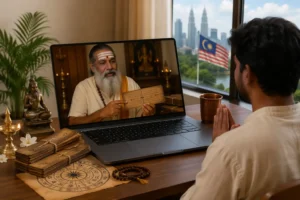
How Your Leaf Is Actually Identified
Nadi astrology sorts thumb impressions into a defined set of classification categories based on ridge and whorl pattern. This is the same starting point for every seeker, regardless of background. Within the bundle matching your specific pattern, a reader searches for the leaf whose recorded details — name initial, family structure, key past events — match your actual, verifiable life.
Nowhere in this process does ethnicity, religion, or nationality function as a filter. The tradition holds that every soul destined to seek a reading has a leaf waiting among the manuscripts — a claim that, notably, doesn’t carve out an exception for non-Tamil or non-Indian seekers.
Why the Question Comes Up So Often in Malaysia
Malaysia’s population is genuinely multicultural — Malay, Chinese, and Indian communities alongside smaller East Malaysian indigenous groups, spanning Islam, Buddhism, Hinduism, Christianity, Taoism, and local spiritual practices. Given that Nadi astrology’s public presence is strongly associated with Tamil heritage and Hindu temple culture, it’s entirely reasonable for someone outside that specific background to wonder whether the tradition “applies” to them.
In practice, we’ve conducted readings for Malaysian clients across a range of backgrounds — including non-Hindu and non-Indian seekers who came in curious but sceptical about whether a Tamil spiritual tradition could say anything meaningful about a life shaped by an entirely different cultural and religious context. The verification step tends to answer that question directly: if the leaf found accurately confirms real, unshared details about a person’s past, the relevance of the reading isn’t really in question anymore, regardless of the seeker’s background.
What Actually Determines Whether a Reading “Works” for You
Rather than heritage, three things matter more:
1. A genuine thumb impression, correctly taken. The classification depends on a clear, accurately captured print — this matters regardless of who’s sending it.
2. Willingness to engage with the verification step honestly. The reader asks direct yes/no questions about your past. Answering them accurately (not trying to guide the reader toward what you expect to hear) is what makes the verification meaningful.
3. Realistic expectations about what a reading offers. A Nadi reading provides a karmic framework and specific remedies — it isn’t a replacement for medical, legal, financial, or psychological professional advice, for any client, of any background.
What About Religious Compatibility?
We’re sometimes asked, directly, whether receiving a Nadi reading conflicts with a different faith tradition. This is a genuinely personal question we wouldn’t presume to answer on someone else’s behalf — what we can say is that clients from Muslim, Christian, Buddhist, and secular backgrounds have sought readings from our centre, and the reading itself doesn’t require adopting any particular religious belief. It’s presented as what it is: an ancient Tamil predictive tradition, offered transparently, for you to engage with on your own terms.
A Practical Note for First-Time Seekers Outside the Tradition
If you’re considering a reading and you’re not from a Tamil or Hindu background, the most useful starting point isn’t researching the theology behind the tradition — it’s simply sending a clear thumb impression and letting the verification stage speak for itself. If the leaf found doesn’t genuinely match your life, that becomes clear quickly, and a transparent centre will tell you so rather than pushing forward with a mismatched reading.
What We’ve Observed Across Different Backgrounds
Over time, a pattern has become clear across the range of Malaysian clients we’ve read for: the accuracy of the verification stage doesn’t correlate with a client’s ethnic or religious background in any way we’ve been able to detect. A Chinese-Malaysian client with no prior connection to Tamil culture experiences the same specific, checkable verification questions as a Tamil-Malaysian client whose family has visited Vaitheeswaran Koil for generations. What varies between clients isn’t accuracy — it’s familiarity with the surrounding cultural and spiritual context, which affects how a reading is experienced, not whether it’s genuine.
This matters because it means a non-Indian, non-Tamil seeker isn’t at any structural disadvantage in getting an accurate reading. What can differ is comfort with unfamiliar terminology — Kandams, Pariharams, Siddhars — which a good reader should be willing to explain plainly rather than assuming prior familiarity.
A Broader Point About Universal Access in Spiritual Traditions
Many spiritual and predictive traditions around the world have, at different points in their history, been treated as exclusive to a particular group — sometimes through genuine doctrinal restriction, sometimes through simple lack of outreach beyond an existing community. Nadi astrology’s actual mechanism — thumb-based identification rather than lineage or birth-based restriction — sets it apart from traditions that build ethnic or religious exclusivity into their structure. This isn’t a modern marketing reframing; it reflects something structurally true about how the tradition has always worked, since the identification method has never depended on who you are demographically, only on your individual thumb pattern.
For non-Indian seekers in Malaysia’s genuinely diverse population, this is worth understanding clearly before deciding whether the tradition is “for them” — the honest answer, structurally, is that it was never built to exclude anyone in the first place.
A Practical Comparison Across a Few Common Scenarios
| Background | Does verification differ? | What might differ |
|---|---|---|
| Tamil Hindu client | No | May already know terms like Kandam, Pariharam |
| Non-Tamil Hindu client | No | Reader explains terminology as it comes up |
| Muslim, Christian, Buddhist, or secular client | No | Reader explains spiritual framing without expecting prior familiarity |
| Client with no prior astrology experience of any kind | No | Slightly longer initial explanation of the overall process |
As the table above illustrates, the one consistent variable across backgrounds is familiarity with terminology and context — not the accuracy or thoroughness of the verification process itself, which remains the same regardless of who’s on the other end of the call.
Frequently Asked Questions
Do I need to be Hindu to get a Nadi reading?
No. Readings are conducted for seekers across religious backgrounds. The process itself doesn’t require adopting any particular faith.
Will my leaf be less accurate if I’m not of Tamil or Indian descent?
No. Leaf identification is based on thumb impression pattern, not ethnicity, so accuracy isn’t tied to ancestry.
What if the verification details don’t match my life at all?
A transparent centre will tell you directly if a leaf doesn’t match, rather than proceeding with an inaccurate reading. This applies to every client, regardless of background.
Can readings be conducted in languages other than Tamil?
Yes. Readings are available in Tamil and English, so language isn’t a barrier for non-Tamil-speaking seekers.
Is this the same tradition referenced in Hindu mythology, or a separate practice?
Nadi astrology is a specific Tamil Siddhar tradition, distinct from horoscope-based Vedic astrology, though both originate within the broader Indian astrological landscape.