
For seekers in Singapore new to Nadi astrology, the thumb impression element is usually the first thing that raises questions — it’s unlike anything else in the astrological landscape most people are familiar with, whether that’s Western zodiac astrology, Chinese astrology, or Vedic birth charts. This guide is written specifically for Singapore-based readers encountering the concept for the first time, walking through how it works and what a first reading actually involves.
Nadi astrology singapore
Why Thumb Impression, and Not Birth Data?
Every other astrological system Singapore residents are likely to have encountered — Western, Chinese, Vedic — starts from your birth date, and often your birth time and location. Nadi astrology starts from something entirely different: a physical, physiological marker that has nothing to do with when or where you were born.
The tradition holds that your thumb impression pattern — right thumb for men, left thumb for women — corresponds to a specific classification among a defined set of categories, each linked to a distinct bundle of palm leaf manuscripts preserved at Vaitheeswaran Koil in Tamil Nadu. Within that bundle, the leaf recorded specifically for you, according to the tradition, can be located and verified.
This matters practically for one specific reason many Singapore clients appreciate: your birth time doesn’t need to be precisely known or recorded. For anyone whose exact birth time wasn’t documented — more common than people assume, particularly for older family members — this removes a barrier that horoscope-based systems can’t get around.
How the Process Works for Singapore-Based Seekers
Step 1: Capture a clear thumb impression. Press your right thumb (if you’re a man) or left thumb (if you’re a woman) firmly onto plain white paper, and photograph it in good, even light, directly overhead, avoiding shadows or smudging.
Step 2: Submit it digitally. Send the photograph via WhatsApp or email, along with your name and a contact number for scheduling.
Step 3: The bundle search. Your thumb pattern is classified, and the corresponding bundle of leaves is searched — typically taking one to seven days, depending on the number of leaves within it.
Step 4: Verification. Once a candidate leaf is identified, a verification session — usually a phone or WhatsApp call — confirms it’s genuinely yours through specific yes/no questions about details from your past.
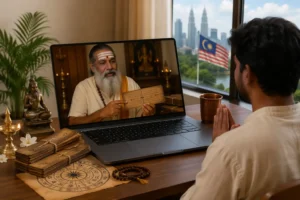
Step 5: Your full reading. Scheduled at a time convenient for Singapore Standard Time, delivered by phone, WhatsApp, or video call, in Tamil or English, and recorded for you to keep.
What Makes This Different From Cold Reading or Generic Prediction
A reasonable scepticism many first-time Singapore clients bring is the concern that any “psychic” or astrological process could simply be a form of cold reading — vague statements that feel personal but could apply broadly. The verification structure here is specifically designed to address that concern directly: rather than offering vague statements you might interpret generously as accurate, the reader asks pointed, specific questions — your name initial, your parents’ details, particular past events — that either match your actual life or don’t. There’s no room for generous interpretation in a genuine verification session; the details either confirm the leaf or they don’t.
Common Questions From First-Time Singapore Clients
“I’ve had my Vedic horoscope calculated before — does that affect this?” No. Nadi astrology and Vedic astrology use entirely different identification methods (thumb impression versus birth chart calculation), so having a previous horoscope reading has no bearing on a Nadi reading, and the two aren’t in conflict with each other.
“Does living in Singapore, outside India, change the leaf that’s found for me?” No. Your leaf is identified through your thumb pattern, not your current location or nationality — the tradition holds that your leaf was recorded for you as an individual soul, regardless of where in the world you currently live.
“What if I have a scar or unclear pattern on my thumb?” A genuine centre will let you know if a submitted impression isn’t clear enough for accurate classification, and will ask for a clearer attempt rather than proceeding with an unreliable print — this is a reasonable thing to ask about directly if it’s a concern for you.
“Is the process different for Singapore residents compared to Malaysian or Indian clients?” No — the identification method, search process, and verification standard are identical regardless of where in the world you’re submitting from. What differs is purely logistical: your session is scheduled to Singapore time, and delivered in your preferred language.
What to Expect From Your First Reading, Realistically
If you’re a first-time seeker in Singapore, set expectations along these lines: the process from submitting your thumb impression to receiving your full reading typically takes one to two weeks. You don’t need to prepare anything beyond the clear thumb impression itself — no birth details, no prior research into Kandams or terminology. The verification session is your opportunity to genuinely test the process; answer honestly rather than agreeably, since the value of that step depends entirely on accurate responses.
A Note on Approaching This With an Open but Discerning Mind
You don’t need to arrive already convinced. The structure of a genuine Nadi reading — verification before prediction — is specifically built to let scepticism be tested against something checkable, rather than asking you to simply trust the process from the outset. For Singapore residents new to the tradition, that’s arguably the most useful thing to understand going in: this isn’t a system asking for faith upfront; it’s one that offers you a direct way to evaluate its credibility before it asks anything of your trust regarding the future.
Singapore’s Own Tamil Heritage Context
Singapore has a long-established Tamil community, with Tamil recognised as one of the nation’s official languages and a rich tradition of temples, cultural institutions, and generational family ties to Tamil Nadu. For Singaporean Tamils, the connection to Vaitheeswaran Koil and the broader Nadi tradition often runs through family history in a similar way to Malaysia’s Tamil community — pilgrimages made by earlier generations, family stories about readings sought decades ago, or simply a general cultural familiarity with the tradition even among those who haven’t personally sought a reading before.
For Singapore’s non-Tamil residents exploring the tradition for the first time, the country’s broader multicultural, multi-religious character — spanning Chinese, Malay, Indian, and other communities — mirrors much of what we’ve covered regarding openness to seekers from any background. The verification-first structure works the same way regardless of a client’s community, and Singapore’s genuinely diverse population reflects the kind of broad accessibility the tradition’s actual mechanism supports.
Frequently Asked Questions
Do I need to send anything besides my thumb impression from Singapore?
No. Your name and a contact number for scheduling, along with a clear thumb impression photograph, are all that’s required to begin.
Will my reading be scheduled around Singapore time?
Yes, sessions are scheduled to work with your local time zone.
Is the accuracy of the process affected by living outside India?
No. Location doesn’t affect leaf identification, which is based entirely on thumb impression pattern.
Can I request a reading in English if I’m not comfortable in Tamil?
Yes, readings are available in Tamil and English based on your preference.
How is this different from a fortune teller or cold reading service in Singapore?
The verification step — confirming specific, checkable details about your past before any prediction — is the key structural difference, and it’s absent from cold-reading-style services.