
Most discussions of Nadi astrology focus on its predictive function — career timing, marriage guidance, health insight. That’s genuinely useful, and it’s what brings most first-time clients to a reading. But within Tamil spiritual tradition, Nadi Jothidam carries a dimension that goes beyond prediction: it’s understood as a form of guidance toward dharma — the right course of action — and toward a soul’s eventual path to moksha, liberation. This piece is written for readers, particularly Tamil families with generational ties to the tradition, who want to understand that deeper spiritual layer, not just the practical mechanics of booking a reading.
Palm leaf reading malaysia
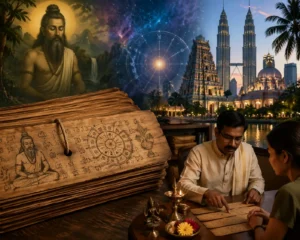
Why the Siddhar Sages Are More Than Historical Figures
Agasthiyar Maharishi, the sage behind our lineage’s leaves, holds a particular place in Tamil spiritual and cultural memory — not simply as a historical astrologer, but as one of the eighteen Siddhars, revered as the father of Tamil language itself, of Siddha medicine, and of astrology as a spiritual discipline. Within this framework, the leaves attributed to him aren’t understood as clever predictions made through some early form of calculation — they’re understood as records left by a being who had transcended ordinary perception, seeing not just what would happen to a soul, but why, in karmic terms, it would happen.
This distinction matters for how the tradition frames a reading’s purpose. A Nadi reading isn’t offered primarily as entertainment or curiosity-satisfaction — it’s offered as a form of spiritual guidance, with the practical predictions serving as one layer of a larger karmic picture.
Dharma as the Underlying Concern
Where Western astrology tends to frame guidance in terms of favourable or unfavourable timing, Nadi Jothidam frames it more specifically around dharma — right action, aligned with one’s karmic path. This is why a reading doesn’t simply tell you what will happen; it typically explains why, in terms of karma carried forward, and prescribes a specific remedy aimed at helping you move through a difficult period in alignment with dharma, rather than simply enduring it.
For Tamil families with a strong grounding in this broader spiritual framework, this dimension often resonates more deeply than the purely predictive content — a difficult period isn’t just something to get through, it’s an opportunity to address a karmic imbalance directly, through specific, prescribed spiritual action.
The Living Connection to Vaitheeswaran Koil
For many Tamil families — in Tamil Nadu itself and across the diaspora, including a substantial Tamil community in Malaysia — Vaitheeswaran Koil isn’t an abstract point of origin for a tradition they’ve only heard about. It’s a place tied to actual family history: a grandparent’s pilgrimage, a wedding blessing sought there, a first reading a parent received decades earlier that’s still spoken about within the family.
This lived connection matters spiritually, not just historically. Many families describe engaging with Nadi Jothidam as a way of staying connected to an ancestral spiritual practice across generations and, for those in the diaspora, across geography — a thread linking a family in Kuala Lumpur or Penang back to a specific temple town in Tamil Nadu that shaped their family’s spiritual life long before they were born.
Pariharam as Spiritual Practice, Not Just Remedy
It’s worth reframing how Pariharams are often described. In purely practical terms, they’re “remedies” — but within the spiritual framework of the tradition, a Pariharam is better understood as a prescribed spiritual practice: a specific temple ritual, a mantra to be recited with genuine devotion, an act of charity undertaken not merely as a transaction but as a sincere spiritual offering aimed at easing a specific karmic imbalance.
Approached this way, engaging with a Pariharam becomes less a checklist item and more a genuine spiritual undertaking — which is also, practically speaking, why clients who engage with remedies sincerely, rather than mechanically, tend to describe more meaningful outcomes from the process.
How This Differs From Treating Nadi Astrology as “Just Prediction”
We think it’s worth naming a common but limiting way of engaging with a Nadi reading: treating it purely as a fortune-telling service, disconnected from any spiritual framework, focused only on extracting specific predictions. This isn’t wrong, exactly — the predictive content is genuinely there and genuinely useful — but it misses the dimension the tradition itself considers central: that a reading is, at its root, about understanding your karmic position and moving through life in better alignment with dharma, not simply about knowing what’s coming next.
A Note for Families Newer to the Tradition
If you’re a Tamil family with less direct generational connection to Nadi Jothidam specifically — perhaps more familiar with Vedic horoscope traditions, or with a less active family history of Nadi readings — you don’t need deep prior spiritual grounding to engage meaningfully with the tradition. The spiritual dimension described here becomes more apparent through direct engagement with a reading — particularly through sincere engagement with any Pariharam prescribed — rather than through study beforehand.
Why This Matters for How You Approach a Reading
Understanding this spiritual dimension changes, in a subtle but real way, how we’d suggest approaching a reading. Rather than arriving purely to extract predictions, consider arriving with genuine openness to the karmic explanation offered — and, if a Pariharam is prescribed, engaging with it as the sincere spiritual practice it’s intended to be, not simply as a task to check off. This is, in our experience, where the tradition’s deeper value tends to be found.
Festivals and Occasions Tied to the Tradition
For Tamil families with an active connection to Nadi Jothidam, certain festival periods and temple occasions at Vaitheeswaran Koil carry particular significance — times when pilgrimage, worship, and consultation naturally intersect. While a reading can be sought at any time of year, some families specifically time a visit or a remedy’s performance around particular auspicious periods within the Tamil calendar, believing this timing enhances the spiritual weight of the Pariharam undertaken. This isn’t a strict requirement of the process — remedies are effective regardless of when they’re performed, according to the tradition — but it reflects how deeply the practice is woven into broader Tamil religious and cultural rhythm for families who engage with it as a living spiritual practice rather than a one-off consultation.
Frequently Asked Questions
Is Nadi Jothidam considered a religious practice, or purely a predictive system?
It’s understood within Tamil tradition as carrying both dimensions — predictive guidance and a spiritual framework oriented around dharma and karmic understanding.
Do I need to be deeply religious to engage with the spiritual side of a reading?
No specific level of prior religious practice is required — the spiritual dimension becomes more apparent through sincere engagement with the reading and any prescribed Pariharam.
Why do Pariharams matter spiritually, not just practically?
Within the tradition, a Pariharam is understood as a genuine spiritual practice aimed at easing karmic imbalance, not simply a practical fix — sincere engagement with it is considered part of its purpose.
Does the spiritual framework mean predictions are less important?
No — the predictive content remains genuinely central to a reading; the spiritual framework offers additional context for understanding and engaging with that content.
How does this connect to a family’s history with Vaitheeswaran Koil specifically?
For many Tamil families, especially in the diaspora, engaging with Nadi Jothidam maintains a living connection to a specific ancestral place and spiritual tradition across generations and geography.